
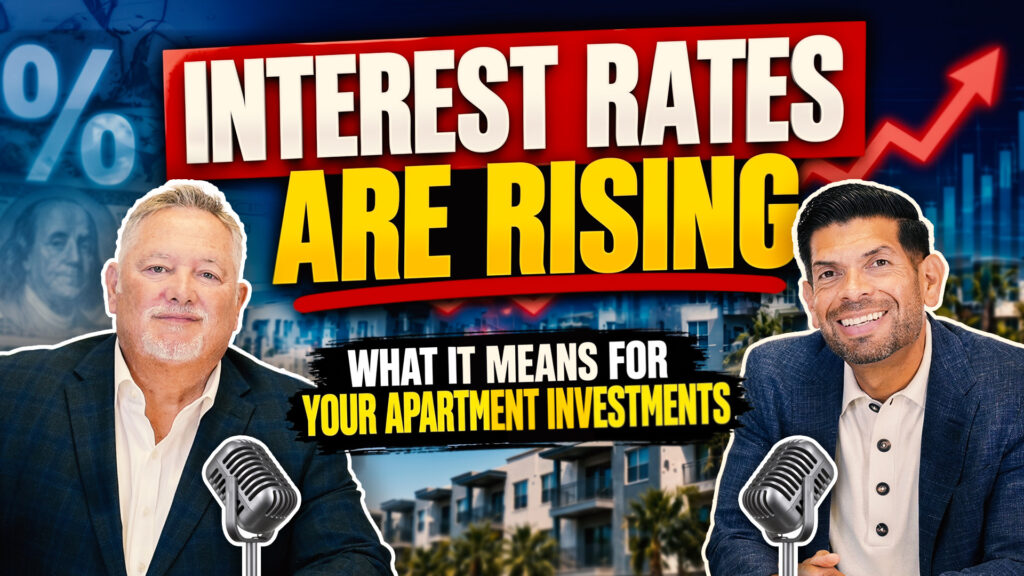

How Are Interest Rates and Commercial Financing Affecting Southern California Multi-Family Investors?
For Southern California Multi-Family Investors, interest rates have become one of the most important numbers to watch. But the rate itself is only part of the story.
Commercial financing affects how much you can borrow, your monthly debt service, your cash flow, what you can afford to pay for a property, and ultimately what that property may be worth. That matters whether you own four units in the San Gabriel Valley, a larger apartment building in Los Angeles County, or you are looking for your first multi-family investment in San Bernardino County or the Inland Empire.
As both a multi-family broker and an investor, I believe this market requires owners to look at financing as part of their overall investment strategy. The question is no longer simply, “What interest rate can I get?” It is, “Does this debt support what I am trying to accomplish with this property?”
In my recent interview with commercial loan broker Gil Figueroa, we broke down how lenders are looking at multi-family loans, why refinancing has become more challenging, and what investors should consider before making their next move.
What Is Commercial Multi-Family Financing?
Commercial multi-family financing is the debt investors use to purchase or refinance apartment properties that are generally treated as commercial real estate.
Unlike a typical residential mortgage, the lender is not looking only at the borrower’s income, credit and down payment. The property’s financial performance plays a major role in determining how much the lender is willing to loan.
One of the most important measurements is the Debt Service Coverage Ratio, or DSCR. DSCR compares a property’s Net Operating Income, or NOI, to its required mortgage payments. In the interview, Gil explained that many lenders he is currently working with look for approximately 1.20 to 1.25 debt-service coverage, although underwriting varies by lender, borrower and loan program.
In simple terms, a 1.20 DSCR means the property needs to produce approximately $1.20 of qualifying NOI for every $1.00 of debt service. That distinction is important for newer investors.
A property can be worth enough to support a loan based on loan-to-value and still fail to qualify for that loan because its income cannot support the debt.
How Do Interest Rates Affect Multi-Family Financing?
Higher interest rates increase the cost of borrowing, which can reduce the amount of debt a property’s income can support.
Imagine two investors evaluating the same apartment property. The property’s NOI has not changed, but financing becomes substantially more expensive. The higher mortgage payment may cause the property to fall below the lender’s required DSCR. The result can be a smaller loan.
That means the buyer may need to contribute more cash to close or negotiate a lower purchase price. For an existing owner refinancing a maturing loan, it may mean contributing additional equity, restructuring the financing, or considering alternatives to refinancing.
This is why Commercial Financing and Interest Rates are directly connected to apartment values and investor returns.
The relationship is especially important in markets such as Los Angeles County and the San Gabriel Valley, where apartment values historically required investors to accept relatively tight returns compared with many markets outside Southern California.
How Do Lenders Determine How Much They Will Loan on an Apartment Building?
For many multi-family loans, lenders look closely at the property’s NOI, DSCR, appraised value, borrower strength, liquidity, credit and experience.
The important point is that the purchase price or appraised value alone does not determine your loan amount. The lender and appraiser also evaluate the property’s income and expenses.
This is where owners can run into problems.
Your own profit-and-loss statement may show one NOI, while an appraiser may determine that certain expenses should be higher based on comparable properties and current market conditions. If the appraiser underwrites higher expenses, the property’s qualifying NOI falls. That lower NOI can result in a lower loan amount.
For Southern California Multi-Family Investors, this has become increasingly important as insurance, utilities, repairs, labor and other ownership expenses have increased.
The NOI you believe your property produces and the NOI a lender is willing to underwrite may not be the same number.
That difference can have a major impact when buying, refinancing or preparing a property for sale.
Why Do Treasury Yields Matter to Multi-Family Investors?
Commercial mortgage rates are often priced using a market index, such as a Treasury yield, plus a lender’s margin.
That is why multi-family investors should pay attention to more than announcements about the Federal Reserve. In our interview, Gil explained that different lenders may price loans from different indexes, including Treasury yields and other benchmarks, then add their lending margin to arrive at the borrower’s rate.
This matters because commercial mortgage rates do not necessarily move in lockstep with the Federal Reserve’s short-term policy rate.
If you are planning to purchase or refinance an apartment building, movements in the benchmark used by your lender can affect your rate, monthly payment and borrowing capacity before you close. That is one reason investors should begin discussing financing well before they actually need the loan.
Why Is Refinancing a Multi-Family Property More Difficult When Rates Rise?
Refinancing becomes more difficult when the new mortgage payment rises faster than the property’s NOI.
This can create a particular challenge for owners who financed apartment buildings when borrowing costs were substantially lower. Many commercial loans have a fixed rate for a limited period. When that fixed period ends, an owner may need to refinance or move into an adjustable-rate period depending on the loan terms.
If the replacement interest rate is significantly higher, the property’s existing income may no longer support the same loan balance. At the same time, if the property’s value has declined, the owner can face pressure from both directions:
Higher debt service can reduce borrowing capacity while a lower valuation can reduce available loan-to-value.
In the interview, we discussed several possible responses depending on the property and owner’s goals, including reducing the loan balance, considering interest-only financing, evaluating alternative loan programs, or deciding whether refinancing is even the best strategy.
Loan availability and terms change frequently, so these strategies need to be evaluated based on the owner’s financial position and current lender programs.
Why Should Southern California Multi-Family Investors Pay Attention Right Now?
Because financing can change the economics of an investment even when nothing has physically changed about the building.
Consider an investor who owns a four-unit property and wants to move into an eight-unit property. The investor may focus first on the equity available from the four-unit building and the purchase price of the replacement property.
But that is only the beginning.
The investor also needs to know:
- How much debt will the eight-unit property’s NOI support?
- What expenses will the lender and appraiser use?
- How much cash will be required after financing?
- What will the property’s cash flow look like after debt service?
- Does the larger property provide enough additional income or upside to justify the move?
For an experienced investor, the same analysis can be applied across an entire portfolio.
One property may have substantial equity but limited upside. Another may have below-market rents, ADU potential, stronger long-term income growth or a more attractive basis.
The best financing decision cannot be made separately from the investment decision.
That was one of the central themes of my conversation with Gil. Before choosing a loan, investors should first determine their objectives for the property. A five-year loan with significant prepayment restrictions may make little sense if the owner’s strategy is to sell the asset in the near future.
Your interest rate matters. Your strategy matters more. The right loan should support the investment plan, not dictate it.
How Are Higher Rates Affecting Multi-Family Property Values?
Higher financing costs can put downward pressure on what buyers are able or willing to pay, but interest rates are not the only factor affecting Southern California apartment values.
Investors evaluate the return they receive relative to the risks and responsibilities of ownership. In Southern California, that calculation can include rent regulation, landlord-tenant laws, insurance costs, maintenance, utilities, labor and other expenses.
As those costs and risks change, buyers may demand a higher return. That can affect capitalization rates and property values even if interest rates eventually decline.
This is particularly important when comparing apartment investments across Los Angeles County, the San Gabriel Valley, San Bernardino County and the broader Inland Empire. Each market has different rents, pricing, local regulations, tenant demand and opportunities for future income growth.
Do not assume that lower interest rates automatically mean your property’s previous value returns.
Financing is one piece of the valuation equation. NOI, cap rates, local regulation, buyer demand, property condition and future income potential matter too.
What Is a “Hurdle Rate” in Multi-Family Lending?
A hurdle rate is a higher assumed interest rate or underwriting standard that a lender may use to test whether a property could still support its debt under more difficult conditions.
For example, a lender may quote a loan based on the current market rate but test the property’s DSCR using a higher rate. That gives the lender additional protection if borrowing costs change or the property’s financial performance weakens.
Gil also explained that some lenders are placing greater emphasis on borrower liquidity and experience. The exact requirements depend on the lender, property and borrower.
For investors, the lesson is straightforward:
Do not assume yesterday’s underwriting standards will apply to tomorrow’s acquisition or refinance.
Can Stronger Borrowers Get Better Multi-Family Loan Terms?
Potentially, yes.
Commercial lending is not always one-size-fits-all. Borrowers with strong liquidity, documented income, good credit, multi-family experience and other assets may have access to financing options that are not available to every investor.
Documentation can matter as well.
Gil explained that some lenders evaluate a borrower’s tax returns and overall financial position, while other “stated” programs may focus more heavily on credit, net worth, liquidity and the property’s financial performance. Those alternative programs can come at a higher borrowing cost.
For aspiring investors, this is an important lesson long before you make your first offer:
Your ability to finance the next property starts before you find the property.
Keeping good records, maintaining liquidity and understanding how lenders will view your financial position can expand your options when the right opportunity appears.
What Are the Key Takeaways for Multi-Family Investors?
- Your property’s income can limit your loan before its value does. Understand DSCR and know how lenders are likely to calculate your property’s qualifying NOI.
- A low existing interest rate can create a future refinancing challenge. If your fixed period is approaching maturity, start analyzing your options early rather than waiting until the loan resets.
- Financing should match your exit strategy. Before accepting a loan, consider how long you expect to own the property and what prepayment restrictions may apply.
- Higher rates can also create buying opportunities. More expensive financing can reduce competition and force the market to reprice. Investors with liquidity and access to the right financing may find opportunities that were difficult to justify when values were higher.
- Evaluate the entire portfolio, not just one loan. Sometimes the right answer is refinancing. Sometimes it is contributing additional capital. Sometimes it may be selling one asset and reallocating that equity into a property with stronger future potential.
A changing multi-family market does not eliminate opportunity. It changes where the opportunity is and how carefully you need to underwrite it.
How Can Multi-Family Investors Capitalize on the Current Financing Market?
Start with these three steps.
First, stress-test your existing debt. If you have a commercial loan approaching the end of its fixed period, determine what the property’s cash flow and DSCR could look like at today’s available financing terms. Do this before you are forced to make a decision.
Second, evaluate your equity. Ask whether the equity in each property is producing an acceptable return. An apartment building can have significant equity and still be a poor use of capital if its income and future upside are limited.
Third, evaluate the property and financing together. If you are considering an acquisition, 1031 Exchange, refinance or sale, determine your likely financing before finalizing your strategy. The purchase price, NOI, loan amount, interest rate and required equity all work together.
For owners in Los Angeles County, San Bernardino County, the San Gabriel Valley and the Inland Empire, this type of analysis can help determine whether the best move is to hold, refinance, improve, exchange or sell.
Diagnostic Portfolio Strategy Review
If you have a commercial loan maturing in the next 12 to 24 months, or if you want to evaluate your property’s Debt Coverage Ratio before interest rates shift again, let us look at the numbers together.
Email me your current rent roll, annual expense summary, and commercial debt terms. I will model a personalized “Keep, Refinance, or Reset” analysis showing your exact property valuation and borrowing capacity today.
📞 (626) 427-0786 | 📧 email@theapartmentdealer.com
Educational only; not legal, financial, or tax advice. Consult your advisors.
FAQ
How do higher interest rates affect the value of my apartment building?
Higher rates can reduce how much buyers are able to borrow and can increase the return buyers require to justify an investment. That can put pressure on apartment values, but rates are only one factor. Your property’s NOI, location, rent potential, expenses, regulations and current buyer demand also affect value.
How much can I borrow to buy a multi-family property?
The amount depends on the lender and loan program, but lenders commonly evaluate the property’s NOI, DSCR, appraised value, your liquidity, credit and experience. The maximum loan based on property value is not necessarily the amount the property’s income can support.
Should I refinance my apartment building if my current rate is adjusting?
Not automatically. First compare the new debt service with your property’s NOI and consider how long you plan to own the property. Depending on your goals, refinancing, contributing cash, using a different loan structure or selling and repositioning the equity could each deserve consideration.
Should I wait for interest rates to fall before buying an apartment building?
Not necessarily. Lower rates can improve financing, but they can also bring more buyers back into the market and increase competition. A better approach is to determine whether the property’s price, income, financing and future upside produce an acceptable investment return based on conditions available to you now.
What is a good DSCR for a multi-family property?
There is no single DSCR requirement for every multi-family loan. In the interview accompanying this article, commercial loan broker Gil Figueroa discussed lenders seeking roughly 1.20 to 1.25 DSCR in many situations, while other programs may underwrite differently. Always confirm current requirements with the lender or commercial mortgage professional evaluating your specific transaction.
Watch More Multi-Family Investor Education
For more insight into today’s Southern California multi-family market, watch these related videos from The Apartment Dealer:
- Southern California Multi-Family Market Update 2026 (Los Angeles & Inland Empire): See how CAP RATES, apartment values, rental trends, regulations, and financing conditions are affecting investors across Southern California.
Watch the Market Update on YouTube - Webinar Replay: California Multi-Family Risks Owners Face in 2026: Hear from our expert panel on the legal, financing, tax, tenant, and investment issues apartment owners should be evaluating in today’s market.
Watch the Webinar Replay on YouTube - The Three Pillars of Financial Legacy for Multi-Family Investors
Kris German explains how Southern California apartment owners can evaluate whether their next move is to maximize current property performance, grow through a 1031 Exchange, or prepare for tomorrow with exit and passive-income strategies.
Watch the Three Pillars Video on YouTube
Ready to Review Your Multi-Family Strategy?
If you own multi-family property in Los Angeles County, San Bernardino County, the San Gabriel Valley or the Inland Empire, we can help you evaluate how today’s financing environment affects your property, equity position, and next investment decision.
Whether you are considering a refinance, acquisition, 1031 Exchange, or sale, the first step is understanding the numbers.
Contact The Apartment Dealer for a custom strategy session.
📞 (626) 427-0786
📧 email@theapartmentdealer.com